
Best Toyota 7-Seater SUVs for Large Families in Orange County
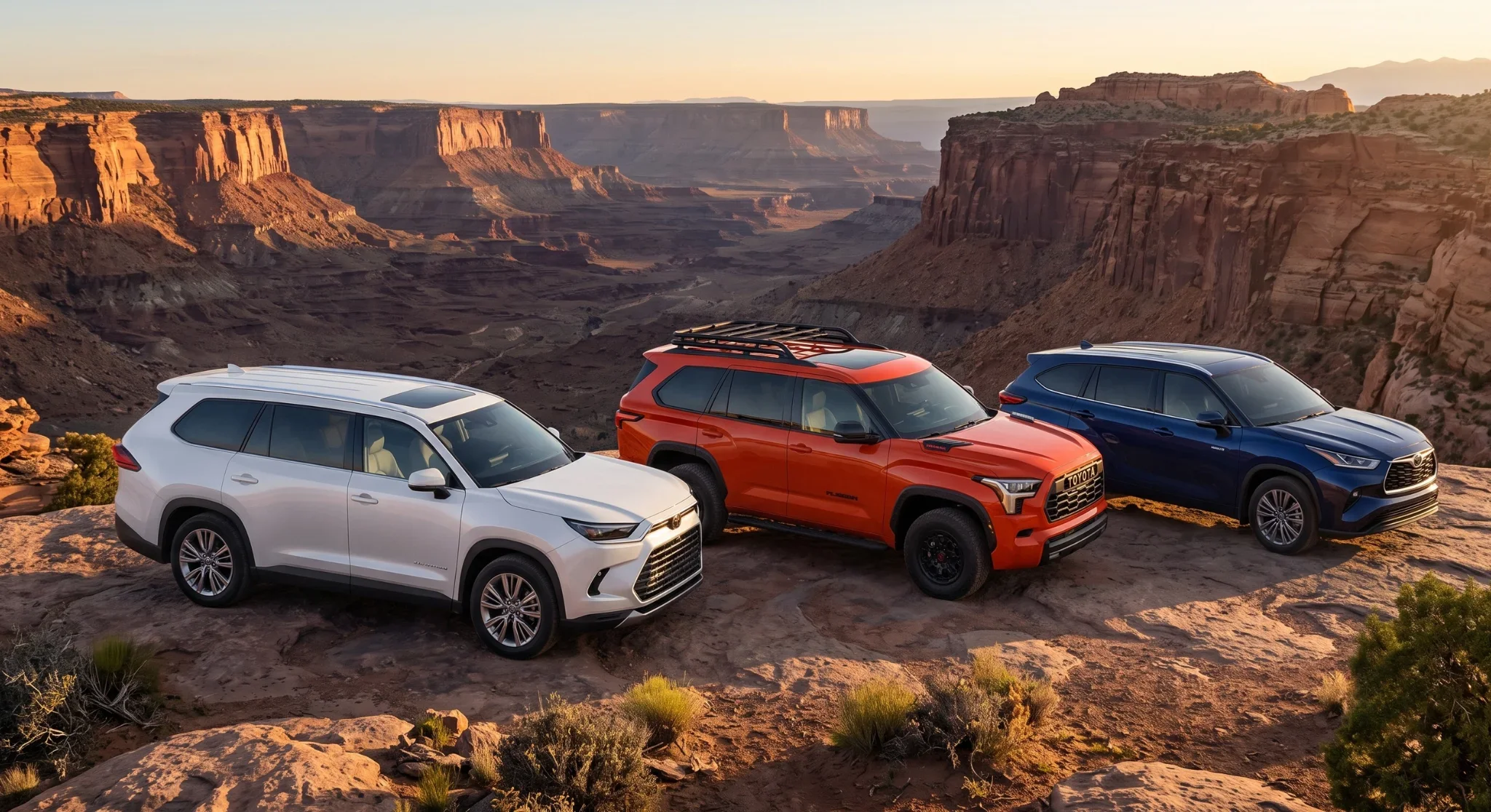
Finding the right balance of passenger capacity and cargo space is often the top priority for growing households. Toyota offers three three-row SUVs for large families — the Highlander, the Grand Highlander, and the body-on-frame Sequoia — plus the Sienna minivan for shoppers who want sliding doors and maximum interior volume. This guide compares the three SUVs side by side so you can find the right fit. Explore our new Toyota inventory to see what is currently in stock.
Which Toyota SUV Fits Your Family?
All three Toyota three-row SUVs seat seven or eight passengers, but they are built for different priorities — from an easy-to-maneuver midsize SUV, to a stretched cabin with an adult-friendly third row, to a full-size hauler with serious towing muscle. Here is how the Highlander, Grand Highlander, and Sequoia compare at a glance.
| Highlander | Grand Highlander | Sequoia | |
|---|---|---|---|
| Best for | Maneuverable midsize daily driver | Adult-friendly third row + cargo | Max power and towing |
| Build | Unibody midsize | Unibody, stretched wheelbase | Body-on-frame full-size |
| Seating | 7 or 8 | 7 or 8 | 7 or 8 |
| Powertrains | Gas or Hybrid | Gas, Hybrid, or Hybrid MAX | Standard i-FORCE MAX hybrid |
Choosing Your Second-Row Layout
Across all three models, a second-row bench maximizes capacity at eight passengers, while second-row captain’s chairs seat seven and create a walk-through aisle to the third row. That aisle is especially valuable for parents managing child safety seats, since older children can reach the back row without folding a seat.
Engine Options and Hybrid Powertrains Compared
These three SUVs do not share one engine. The Highlander and Grand Highlander offer a turbo gas four and efficient hybrids, the Grand Highlander adds a high-output Hybrid MAX, and the Sequoia comes only as a powerful i-FORCE MAX hybrid V6. The table below compares each model’s available powertrains.
| Highlander | Grand Highlander | Sequoia | |
|---|---|---|---|
| Gas engine | 2.4L Turbo I4 · 265 hp / 310 lb-ft | 2.4L Turbo I4 · 265 hp / 310 lb-ft | Hybrid only (no gas-only engine) |
| Standard hybrid | 2.5L Hybrid · 243 hp | 2.5L Hybrid · 245 hp | i-FORCE MAX V6 · 437 hp / 583 lb-ft |
| Top hybrid | 2.5L Hybrid · 243 hp | Hybrid MAX · 362 hp / 400 lb-ft | i-FORCE MAX V6 · 437 hp / 583 lb-ft |
| Transmission | 8-speed auto (gas); eCVT (hybrid) | 8-speed auto / eCVT / 6-speed auto (MAX) | 10-speed automatic |
| Drivetrain | Standard AWD (gas & hybrid) | FWD or AWD (MAX is AWD) | RWD or part-time 4WD |
Seating and Cargo Space Compared
All three seat up to eight, but usable third-row and cargo room differ significantly. The Grand Highlander leads for combined third-row comfort and everyday cargo, while the Sequoia’s solid rear axle and hybrid battery trim its behind-the-third-row space despite its full-size footprint.
| Highlander | Grand Highlander | Sequoia | |
|---|---|---|---|
| Seating capacity | 7 or 8 | 7 or 8 | 7 or 8 |
| Third-row legroom | Best for kids (tightest of the three) | 33.5 in | 33.7 in |
| Cargo behind 3rd row | 16 cu ft | 20.6 cu ft | 11.5–22.3 cu ft (sliding) |
| Cargo behind 2nd row | 48.4 cu ft | 57.9 cu ft | 49 cu ft |
| Max cargo | 84.3 cu ft | 97.5 cu ft | 86.9 cu ft |
Towing Capability Compared
If towing is on your list, the Sequoia stands apart. A common question is whether a hybrid means giving up utility — the Grand Highlander Hybrid MAX answers that by matching the turbo gas model’s rating, while the Sequoia’s i-FORCE MAX system delivers full-size towing muscle.
| Highlander | Grand Highlander | Sequoia | |
|---|---|---|---|
| Gas / Turbo | 5,000 lbs | 5,000 lbs | Not offered |
| Standard hybrid | 3,500 lbs | 3,500 lbs | 9,520 lbs |
| Top hybrid | 3,500 lbs | 5,000 lbs (Hybrid MAX) | 9,520 lbs (i-FORCE MAX) |
Before You Tow, Remember
- Towing capacity includes the weight of the trailer, its cargo, and passengers in the vehicle.
- Ratings require a properly equipped vehicle with the correct factory receiver hitch and wiring.
- Always check your owner’s manual and the vehicle’s door-jamb label for your specific configuration.
Maximum towing and payload capacity figures are based on properly equipped vehicles and vary by configuration. Do not exceed any weight rating. See your owner’s manual and the vehicle’s door-jamb label for specific capacities.
EPA-Estimated Fuel Economy Compared
The Highlander and Grand Highlander hybrids lead the group for efficiency, while the Sequoia trades some economy for full-size capability — though it still outpaces most V8-powered full-size rivals. All figures are EPA-Estimated (city / highway / combined) and vary by drivetrain.
| Configuration | Highlander | Grand Highlander | Sequoia |
|---|---|---|---|
| Gas, front/rear-wheel drive | 21 / 28 / 24 (AWD std) | 21 / 28 / 24 (FWD) | 21 / 24 / 22 (RWD) |
| Gas, AWD/4WD | 21 / 28 / 24 | 21 / 27 / 23 (LE/XLE) · 20 / 26 / 22 (Ltd/Plat) | 19 / 22 / 20 (4WD) |
| Standard hybrid | 35 / 35 / 35 (AWD) | 37 / 34 / 36 (FWD) | 21 / 24 / 22 (RWD) |
| Hybrid, AWD/4WD | 35 / 35 / 35 | 36 / 32 / 34 | 19 / 22 / 20 |
| Top hybrid (performance) | 35 / 35 / 35 | 26 / 27 / 27 (Hybrid MAX) | 19 / 22 / 20 (i-FORCE MAX 4WD) |
EPA-estimated fuel economy figures are for comparison purposes only. Your actual mileage will vary depending on driving conditions, how you drive and maintain your vehicle, battery age/condition, and other factors.
Driver-Assist Safety Compared
Every one of these SUVs comes standard with a comprehensive Toyota Safety Sense suite. The Grand Highlander carries the newest generation, TSS 3.0, which adds Proactive Driving Assist, while the Highlander and Sequoia use the well-established TSS 2.5-series suite. Core collision-avoidance features are standard on all three.
| Highlander | Grand Highlander | Sequoia | |
|---|---|---|---|
| Standard suite | TSS 2.5+ | TSS 3.0 | TSS 2.5 |
| Pre-Collision w/ Pedestrian Detection | Standard | Standard | Standard |
| Full-Speed Dynamic Radar Cruise Control | Standard | Standard | Standard |
| Lane Departure Alert w/ Steering Assist | Standard | Standard | Standard |
| Blind Spot Monitor w/ Rear Cross-Traffic Alert | Standard | Standard | Standard |
| Proactive Driving Assist (TSS 3.0) | Not included | Standard | Not included |
How Well-Equipped Is the Entry Trim?
You do not need a top trim to get modern family features. Each model’s entry grade arrives well-equipped — the Highlander XLE and Grand Highlander XLE lead with hybrid availability and wireless smartphone connectivity, while the Sequoia SR5 packs full-size comfort and standard hybrid power.
| Standard on entry trim | Highlander XLE | Grand Highlander XLE | Sequoia SR5 |
|---|---|---|---|
| Safety suite | TSS 2.5+ | TSS 3.0 | TSS 2.5 |
| Touchscreen | 8-inch | 12.3-inch | 8-inch |
| Wireless Apple CarPlay / Android Auto | Standard | Standard | Standard |
| Heated front seats | Standard | Standard | Standard |
| Power liftgate | Hands-free | Standard | Standard |
| Digital gauge cluster | 7-inch | 7-inch | 12.3-inch |
Stepping up each lineup adds leather seating, larger displays, JBL premium audio, and features like a panoramic roof, Head-Up Display, and a 360-degree camera on the top grades.
Reliability and Hybrid Ownership
Toyota’s reputation for long-term dependability shows up clearly across its hybrid three-row SUVs. Because Toyota has refined its hybrid system over decades, these powertrains have fewer wearing parts than a conventional automatic, and regenerative braking eases wear on brake pads and rotors over time. The self-charging hybrids never need to be plugged in.
| Coverage | Highlander Hybrid | Grand Highlander Hybrid | Sequoia |
|---|---|---|---|
| Hybrid battery warranty | 10 yr / 150,000 mi | 10 yr / 150,000 mi | 10 yr / 150,000 mi |
| Hybrid system components | 8 yr / 100,000 mi | 8 yr / 100,000 mi | 8 yr / 100,000 mi |
| Basic new-vehicle warranty | 3 yr / 36,000 mi | 3 yr / 36,000 mi | 3 yr / 36,000 mi |
| Plug-in required? | No (self-charging) | No (self-charging) | No (self-charging) |
Hybrid battery coverage applies to 2020 model year and newer. This long-term coverage and low upkeep also make a pre-owned Toyota hybrid a strong value.
This information is provided for general educational purposes only and does not constitute legal advice. Warranty coverage depends on the specific terms of your vehicle’s warranty agreement. Consult your owner’s manual or a qualified legal professional for guidance on your individual situation.
Common Questions About Toyota Three-Row Family Vehicles
Which has the most usable third row?
The Grand Highlander is designed to seat adults comfortably in back, thanks to its longer wheelbase and squared-off roofline. The Sequoia offers similar legroom on paper but a higher floor, while the standard Highlander’s third row is best for occasional use and younger children.
Do these hybrids need to be plugged in?
No. The hybrid models are self-charging — they recharge automatically through regenerative braking and engine power, so there is no charging routine to manage.
Which should I choose for towing?
For light-duty towing, the Grand Highlander Hybrid MAX or a turbo gas Highlander or Grand Highlander handles up to 5,000 lbs. For serious towing, the Sequoia’s i-FORCE MAX system is rated up to 9,520 lbs when properly equipped.
Where to Test Drive These Toyota SUVs in Orange County
The best way to choose among Toyota’s three-row SUVs is to experience the cabin space and driving dynamics firsthand. Located in the Tustin Auto Center, our showroom is easy to reach for families across Orange County — including Irvine, Orange, Costa Mesa, and Anaheim. Browsing deals first? Check our new vehicle specials before you visit.
On Your Visit, Our Team Can Help You
- Compare the Highlander, Grand Highlander, and Sequoia cargo areas side by side.
- See how easily the second-row seats slide and fold for third-row access.
- Sit in the third row of each model to judge real-world legroom.
We are committed to a transparent, pressure-free shopping experience for every guest.
Disclaimers
Towing and Payload
Maximum towing and payload capacity figures are based on properly equipped vehicles and vary by configuration. Do not exceed any weight rating. See your owner’s manual and the vehicle’s door-jamb label for specific capacities.
EPA-Estimated Fuel Economy
EPA-estimated fuel economy figures are for comparison purposes only. Your actual mileage will vary depending on driving conditions, how you drive and maintain your vehicle, battery age/condition, and other factors.
Warranty and Legal/Educational
This information is provided for general educational purposes only and does not constitute legal advice. Warranty coverage depends on the specific terms of your vehicle’s warranty agreement. Consult your owner’s manual or a qualified legal professional for guidance on your individual situation.