

How Long Does a Toyota Camry Battery Last?
Your Camry has two batteries, and they are not on the same clock. The high-voltage hybrid battery that drives the electric motors is a long-life component backed by Toyota’s longest warranty. The 12-volt battery that wakes the car up and runs its electronics is a wear item. You will likely replace it more than once over the life of the car.
Knowing which battery is acting up saves a lot of guesswork, and often a lot of money. Toyota’s own coverage is the clearest answer to the lifespan question. On 2020 and newer Toyota hybrids, the high-voltage battery is covered for 10 years or 150,000 miles, whichever comes first.
This information is provided for general educational purposes only and does not constitute legal advice. Warranty coverage depends on the specific terms of your vehicle’s warranty agreement. Consult your owner’s manual or a qualified legal professional for guidance on your individual situation.
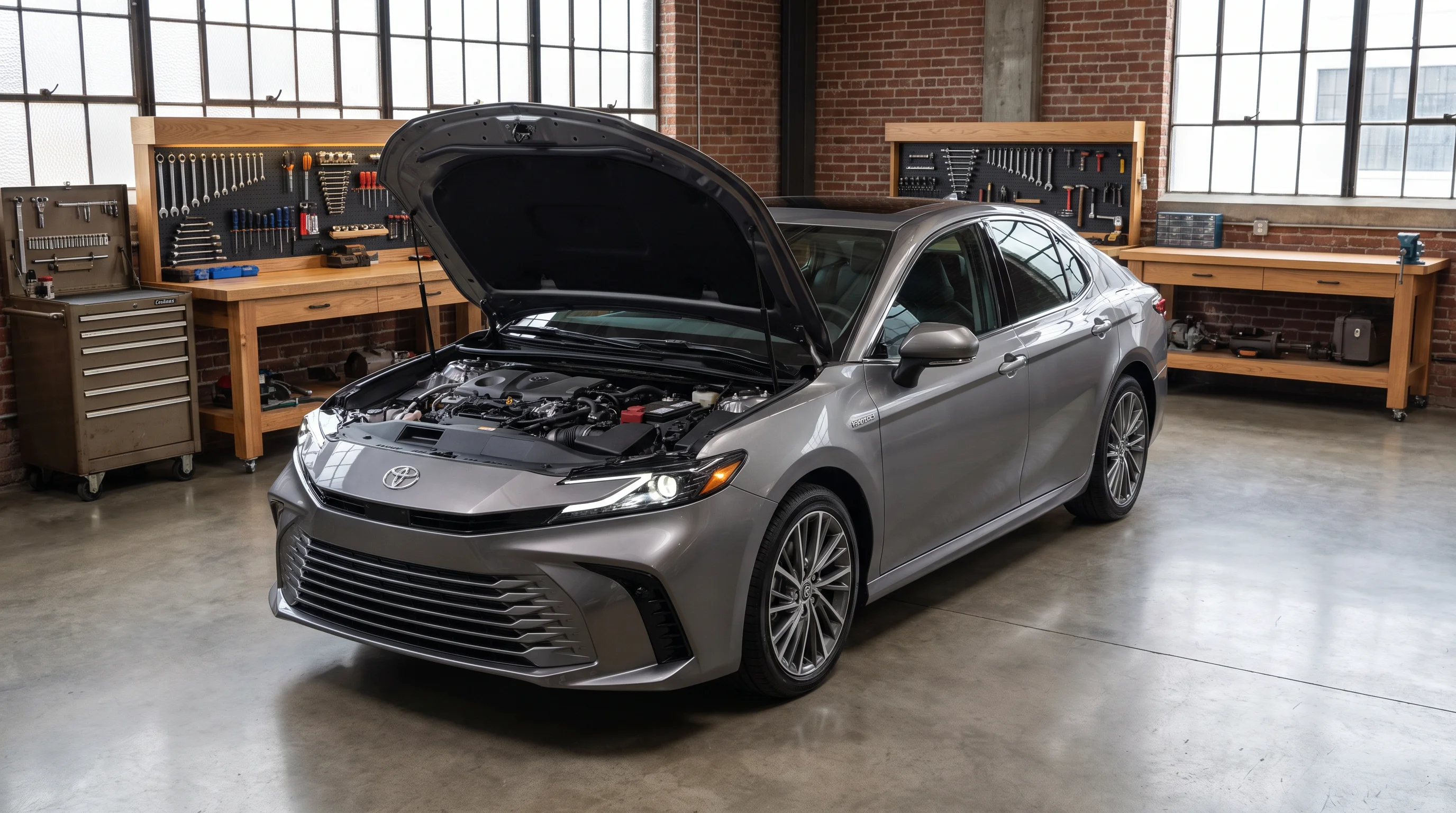
Your Camry’s Two Batteries at a Glance
Most battery confusion comes from treating these two as one part. They do different jobs, fail in different ways, and are covered differently.
| High-Voltage Hybrid Battery | 12-Volt Battery | |
|---|---|---|
| What it does | Powers the electric motors that move the car | Powers the control units, the electronics, and the start-up sequence |
| Warning signs | Falling fuel economy, the gas engine running constantly, the charge display swinging, reduced power with warning lights | Slow cranking, dimming or flickering lights, inconsistent electronics, corroded terminals or a swollen case |
| Factory coverage | 10 years or 150,000 miles on 2020 and newer Toyota hybrids | Not covered by the hybrid battery warranty |
This information is provided for general educational purposes only and does not constitute legal advice. Warranty coverage depends on the specific terms of your vehicle’s warranty agreement. Consult your owner’s manual or a qualified legal professional for guidance on your individual situation.
What Toyota’s Hybrid Battery Warranty Covers
On 2020 and newer Toyota hybrids, Toyota’s published warranty terms cover the high-voltage battery and the surrounding hybrid system components on two separate schedules.
| Coverage | Term | What It Covers |
|---|---|---|
| High-Voltage Hybrid Battery | 10 years / 150,000 miles, whichever comes first, from date of first use | The hybrid battery pack itself |
| Hybrid System Components | 8 years / 100,000 miles, whichever comes first | Hybrid battery control module, hybrid control module, and inverter with converter |
This information is provided for general educational purposes only and does not constitute legal advice. Warranty coverage depends on the specific terms of your vehicle’s warranty agreement. Consult your owner’s manual or a qualified legal professional for guidance on your individual situation.
Coverage Follows the Car, Not the Buyer
The warranty is not limited to the original buyer. Toyota’s hybrid battery coverage applies to the first owner and all subsequent owners. If you bought your Camry Hybrid used, whatever factory coverage remained came with the car.
The clock starts at the vehicle’s date of first use. That is the day it was first delivered to a retail buyer, leased, or put into service as a demonstrator. It does not start on the day you bought it. Pinning down that date tells you exactly how much factory coverage is left.
It is also worth saying plainly that a warranty term is a coverage commitment, not an expiration date for the hardware. Many hybrid batteries keep working past the end of the warranty window. The warranty simply defines the period during which Toyota, rather than you, carries the risk.
What Affects Hybrid Battery Life
Heat and inactivity are the two forces working against a high-voltage battery.
Heat and Airflow
The hybrid battery is cooled by air drawn from inside the cabin through dedicated intake vents near the rear seats. Anything that blocks those vents stops air from moving across the battery modules. Seat covers, a jacket, or luggage pushed up against them will all do it.
Over time, dust and pet hair clog the intake filter screen and the pack runs hotter than it should. Heat accelerates the chemical degradation inside the cells. Having the hybrid cooling fan screen inspected and cleaned is one of the few genuinely preventive things an owner can do, and it belongs on your Camry’s recommended maintenance schedule.
Parking habits matter for the same reason. A car left in full sun all afternoon builds up cabin temperatures that soak into the battery enclosure. A shaded space or a windshield sunshade keeps those peaks down.
Inactivity
A hybrid battery is healthiest when it is being used. It charges itself as you drive, fed by both the gasoline engine and regenerative braking, as the U.S. Department of Energy describes. That constant charge and discharge keeps the cells balanced and active.
A car that sits for weeks at a time does not get any of that. Driving the car regularly is, unglamorously, good battery maintenance.
Signs Your Camry Hybrid Battery Is Failing
Hybrid batteries rarely fail without warning. The symptoms worth paying attention to are:
- Fuel economy dropping noticeably with no change in how or where you drive.
- The gas engine running almost constantly, including while coasting or stopped at a light.
- The charge display on the instrument panel swinging from full to low within a few blocks.
- Warning lights accompanied by noticeably reduced acceleration.
That last one is the vehicle protecting itself. When the system detects a serious high-voltage fault, it limits power so you can pull over safely. Reduced power paired with warning lights is not a condition to keep driving on.
If you are seeing any of these signs, a diagnostic visit is the right next step. Technicians connect factory diagnostic software to read individual module voltages, internal cell resistance, and the pack’s recorded temperature history. Those readings separate a genuinely degrading battery from the cheaper problems that imitate one.
Not every warning light points to the battery. It helps to know what the maintenance required light on a Camry is actually telling you.
The information in this article is general guidance and does not constitute a specific diagnostic or repair recommendation for any individual vehicle. Repair and maintenance decisions should be made in consultation with a certified technician based on the specific condition of your vehicle.
Factory or Reconditioned: Choosing a Replacement
If a pack does need replacing, the real decision is between a new factory unit and a reconditioned assembly.
A factory Toyota replacement gives you exact fitment, battery management programming matched to your vehicle, and Toyota replacement parts coverage behind it. A reconditioned unit costs less up front. What you are buying, though, is a pack assembled from cells of varying age and condition, and its remaining service life varies accordingly.
The gasoline engine and transmission in a Camry Hybrid are built for long service. A mechanically sound car with a worn battery is often worth keeping, because the rest of the vehicle still has years left in it.
Pricing depends on your vehicle’s model year, its configuration, and what the diagnostic actually finds. For a current quote on hybrid battery diagnosis or replacement, call our service center at 714-462-9434.
Don’t Overlook the 12-Volt Battery
Every Camry, hybrid or not, also carries a conventional 12-volt battery. It does not drive the car. It powers the control units, the electronics, and the start-up sequence. When it weakens, the symptoms can look far more alarming than the problem actually is.
In a hybrid, a failing 12-volt battery can trigger hybrid system warning lights even when the high-voltage pack is perfectly healthy. If its voltage drops too low, the hybrid computer cannot complete its boot sequence cleanly. The dashboard then reports a hybrid system fault that is really a much smaller problem in disguise. It is one of the most common false alarms in hybrid service.
What Shortens 12-Volt Battery Life
Heat
Warm weather is hard on 12-volt batteries. It speeds up the internal chemistry that wears them out.
Short Trips
Frequent brief drives may not give the charging system enough time to replace what starting the car consumed.
Accessory Draw
Running lights, audio, or chargers with the engine off pulls from the battery with nothing replacing it.
Loose Mounting and Corroded Terminals
Vibration damages a battery that is not properly secured. Buildup on the terminals interferes with the electrical connection.
Signs Your 12-Volt Battery Needs Attention
- Slow or labored cranking at start-up.
- Headlights or dashboard lights dimming or flickering, especially at idle.
- Power windows, audio, or other electronics behaving inconsistently.
- Corrosion on the terminals, a swollen or bulging case, or a sulfur smell. Any of these should be looked at promptly.
More answers to common questions are in our service FAQ.
The information in this article is general guidance and does not constitute a specific diagnostic or repair recommendation for any individual vehicle. Repair and maintenance decisions should be made in consultation with a certified technician based on the specific condition of your vehicle.
Camry Battery Questions, Answered
Does extreme weather change how my hybrid battery performs day to day?
Yes, in both directions. Heat raises internal resistance in the battery cells and makes the cooling fan work harder to regulate temperature. Cold slows the internal chemistry, which temporarily reduces how much energy regenerative braking can absorb and how much electric-only driving you get until the battery reaches its normal operating temperature.
Can a weak 12-volt battery cause hybrid system warning lights?
Yes. The 12-volt battery powers the vehicle’s electronic control units and start-up relays. If its voltage drops too low, the hybrid computer cannot complete its boot sequence cleanly, and the car may report a hybrid system fault even though the high-voltage battery is healthy.
Does hybrid battery warranty coverage transfer if I buy the car used?
Yes. Toyota’s hybrid battery coverage applies to the first owner and all subsequent owners. Coverage is tied to the vehicle and runs from its original date of first use, so what matters is the car’s age and mileage rather than when you bought it.
This information is provided for general educational purposes only and does not constitute legal advice. Warranty coverage depends on the specific terms of your vehicle’s warranty agreement. Consult your owner’s manual or a qualified legal professional for guidance on your individual situation.
Does driving in EV Mode wear out the hybrid battery?
No. The hybrid system monitors power draw continuously and will exit EV Mode on its own, engaging the gasoline engine, if the charge level drops below its threshold or if you ask for more acceleration than the battery alone can deliver.
What happens during a hybrid battery health check?
A technician connects factory diagnostic software and reads individual module block voltages, internal cell resistance, and the battery pack’s recorded temperature history. Those readings show whether the pack itself is degrading or whether something else is producing the symptoms.
Hybrid and Battery Service at Tustin Toyota
Need a hybrid system health check, a fresh cooling vent filter, or a 12-volt battery test? Our factory-trained technicians can help. They can also tell you how much factory coverage is left on your car.
We serve Camry owners across Tustin, Irvine, Orange, Anaheim, Costa Mesa, and Huntington Beach from 36 Auto Center Dr, Tustin, CA 92782. Schedule service online, or call our service center at 714-462-9434.
Disclaimers
The information in this article is general guidance and does not constitute a specific diagnostic or repair recommendation for any individual vehicle. Repair and maintenance decisions should be made in consultation with a certified technician based on the specific condition of your vehicle.
This information is provided for general educational purposes only and does not constitute legal advice. Warranty coverage depends on the specific terms of your vehicle’s warranty agreement. Consult your owner’s manual or a qualified legal professional for guidance on your individual situation.