
2026 Toyota Tundra Engine Specs: i-FORCE and i-FORCE MAX Powertrains
The 2026 Toyota Tundra is powered exclusively by twin-turbocharged 3.4-liter V6 engines. Two powertrains produce three output levels: the gas i-FORCE V6 in a 348-horsepower tune on the SR and a 389-horsepower tune from SR5 upward, and the i-FORCE MAX hybrid, which pairs the same V6 with an electric motor generator for 437 horsepower and 583 lb-ft of torque. Every 2026 Tundra uses a 10-speed Electronically Controlled Automatic Transmission with intelligence (ECT-i). A V8 is no longer offered.
What Engine Options Are Available in the 2026 Toyota Tundra?
The third-generation Tundra is built on Toyota’s TNGA-F body-on-frame platform, which replaced the previous naturally aspirated V8 with forced induction across the entire lineup. In its standard tune, Toyota rates the i-FORCE twin-turbo V6 at 389 horsepower and 479 lb-ft of torque, using DOHC 24-valve cylinder heads and Dual VVT-i.
i-FORCE Engine Construction
Both the gas i-FORCE and the hybrid i-FORCE MAX share the same base engine. The figures below come from Toyota vehicle specification data for the 2026 Tundra.
| Specification | i-FORCE 3.4L Twin-Turbo V6 |
|---|---|
| Engine code | V35A-FTS |
| Displacement | 3,445 cc (3.4 liters) |
| Configuration | 60-degree V6, twin-turbocharged |
| Block and head material | Aluminum block, aluminum cylinder heads |
| Valvetrain | DOHC, 24 valves, Dual VVT-i |
| Bore x stroke | 85.5 mm x 100 mm |
| Compression ratio | 10.4:1 |
| Fuel requirement | Regular unleaded |
Transmission and Drivetrain
Power is routed through the 10-speed ECT-i automatic, which includes a sequential shift mode, uphill/downhill shift logic, and TOW/HAUL driving modes. Rear-wheel drive is standard on most grades. Part-time four-wheel drive with a two-speed transfer case is available across the range and standard on the TRD Pro and Capstone. The Tundra does not offer an all-wheel-drive system.
2026 Tundra Powertrain Specifications
| Powertrain | Engine | Horsepower | Torque | Transmission | Drivetrain | Available On |
|---|---|---|---|---|---|---|
| i-FORCE (standard output) | 3.4L twin-turbo V6 | 348 hp @ 5,200 rpm | 405 lb-ft @ 2,000 rpm | 10-speed ECT-i automatic | RWD or part-time 4WD | SR |
| i-FORCE (high output) | 3.4L twin-turbo V6 | 389 hp @ 5,200 rpm | 479 lb-ft | 10-speed ECT-i automatic | RWD or part-time 4WD | SR5, Limited, Platinum, 1794 Edition |
| i-FORCE MAX hybrid | 3.4L twin-turbo V6 plus electric motor generator | 437 hp @ 5,200 rpm (net combined) | 583 lb-ft @ 2,400 rpm | 10-speed ECT-i automatic | RWD or part-time 4WD; 4WD standard on TRD Pro and Capstone | Standard on TRD Pro and Capstone; available on Limited, Platinum, 1794 Edition |
How Engine Output Varies by Tundra Grade
The SR runs a lower-output calibration of the same 3.4-liter twin-turbo V6, rated at 348 horsepower at 5,200 rpm and 405 lb-ft of torque. Every grade from the SR5 upward — SR5, Limited, Platinum, and 1794 Edition — receives the 389-horsepower, 479-lb-ft tune. The gap between the two calibrations is 41 horsepower and 74 lb-ft of torque.
Mechanically, both tunes share the same engine block, cylinder heads, and 10-speed transmission. The SR’s lower rating reflects calibration, not different hardware.
The i-FORCE MAX hybrid is standard on the TRD Pro and Capstone and available on the Limited, Platinum, and 1794 Edition. It is not offered on the SR or SR5. The 2026 Tundra is sold in seven grades: SR, SR5, Limited, Platinum, 1794 Edition, TRD Pro, and Capstone. Grade-by-grade configuration and pricing detail is covered on our 2026 Tundra trims and pricing page.
What Are the Power and Torque Specs for the 2026 Tundra i-FORCE MAX Hybrid Engine?
The i-FORCE MAX produces 437 net combined horsepower at 5,200 rpm and 583 lb-ft of torque at 2,400 rpm. Toyota achieves this by placing a motor generator, with a clutch, inside the bell housing between the engine and the 10-speed automatic transmission. The motor generator supplies additional power through the transmission and also handles engine start-up, EV driving, electric assist, and energy regeneration.
i-FORCE MAX Hybrid System Components
| Component | Specification |
|---|---|
| Hybrid system type | Parallel hybrid; no plug-in charging |
| Electric motor type | Permanent magnet synchronous motor generator |
| Electric motor output | 48 hp (36 kW) |
| Electric motor torque | 184 lb-ft (250 Nm) |
| Motor location | Bell housing, between engine and transmission |
| Battery type | Sealed nickel-metal hydride (Ni-MH) |
| Battery capacity | 1.87 kWh |
| Battery voltage | 288 volts |
| Net combined output | 437 hp / 583 lb-ft |
Torque Low in the Rev Range
Peak torque arrives at 2,400 rpm, so the i-FORCE MAX delivers its pulling power early rather than at the top of the tachometer. This is a performance-oriented hybrid rather than an efficiency-first one, and its combined output is the highest of any powertrain in the Tundra lineup.
No Plug Required
The battery charges itself. Regenerative braking recovers energy during deceleration and the gas engine charges the battery as needed, so there is no plug and no charging station. You can browse our i-FORCE MAX hybrid inventory to see which hybrid grades are in stock now.
What Is the EPA-Estimated Fuel Economy for the 2026 Tundra?
Toyota publishes EPA-estimated fuel economy for the 2026 Tundra by powertrain, drivetrain, and grade group rather than by individual configuration. The i-FORCE MAX in rear-wheel drive is the most efficient combination in the lineup at an EPA-estimated 20 mpg city, 24 mpg highway, and 22 mpg combined. Notably, the gas-only SR in rear-wheel drive matches the hybrid’s 24 mpg highway estimate.
For 2026, every Tundra carries a 32.2-gallon fuel tank as standard equipment. Toyota discontinued the smaller tank option across the lineup.
2026 Tundra EPA-Estimated Fuel Economy by Powertrain
All figures below are Toyota’s published EPA-estimated ratings for the 2026 Tundra. Ratings can also be looked up on the EPA and U.S. Department of Energy site at fueleconomy.gov.
| Powertrain | Drivetrain | Grades | EPA-Estimated City | EPA-Estimated Highway | EPA-Estimated Combined |
|---|---|---|---|---|---|
| i-FORCE gas | 4×2 | SR | 18 mpg | 24 mpg | 20 mpg |
| i-FORCE gas | 4×2 | SR5, Limited, Platinum, 1794 Edition | 18 mpg | 23 mpg | 20 mpg |
| i-FORCE gas | 4×4 | SR | 17 mpg | 22 mpg | 19 mpg |
| i-FORCE gas | 4×4 | SR5, Limited, Platinum, 1794 Edition | 17 mpg | 22 mpg | 19 mpg |
| i-FORCE MAX hybrid | 4×2 | Limited, Platinum, 1794 Edition | 20 mpg | 24 mpg | 22 mpg |
| i-FORCE MAX hybrid | 4×4 | Limited, Platinum, 1794 Edition, Capstone | 19 mpg | 22 mpg | 20 mpg |
| i-FORCE MAX hybrid | 4×4 | TRD Pro | 18 mpg | 20 mpg | 19 mpg |
EPA-estimated fuel economy figures are for comparison purposes only. Your actual mileage will vary depending on driving conditions, how you drive and maintain your vehicle, battery age/condition, and other factors.
How the Tundra’s Powertrains Support Towing
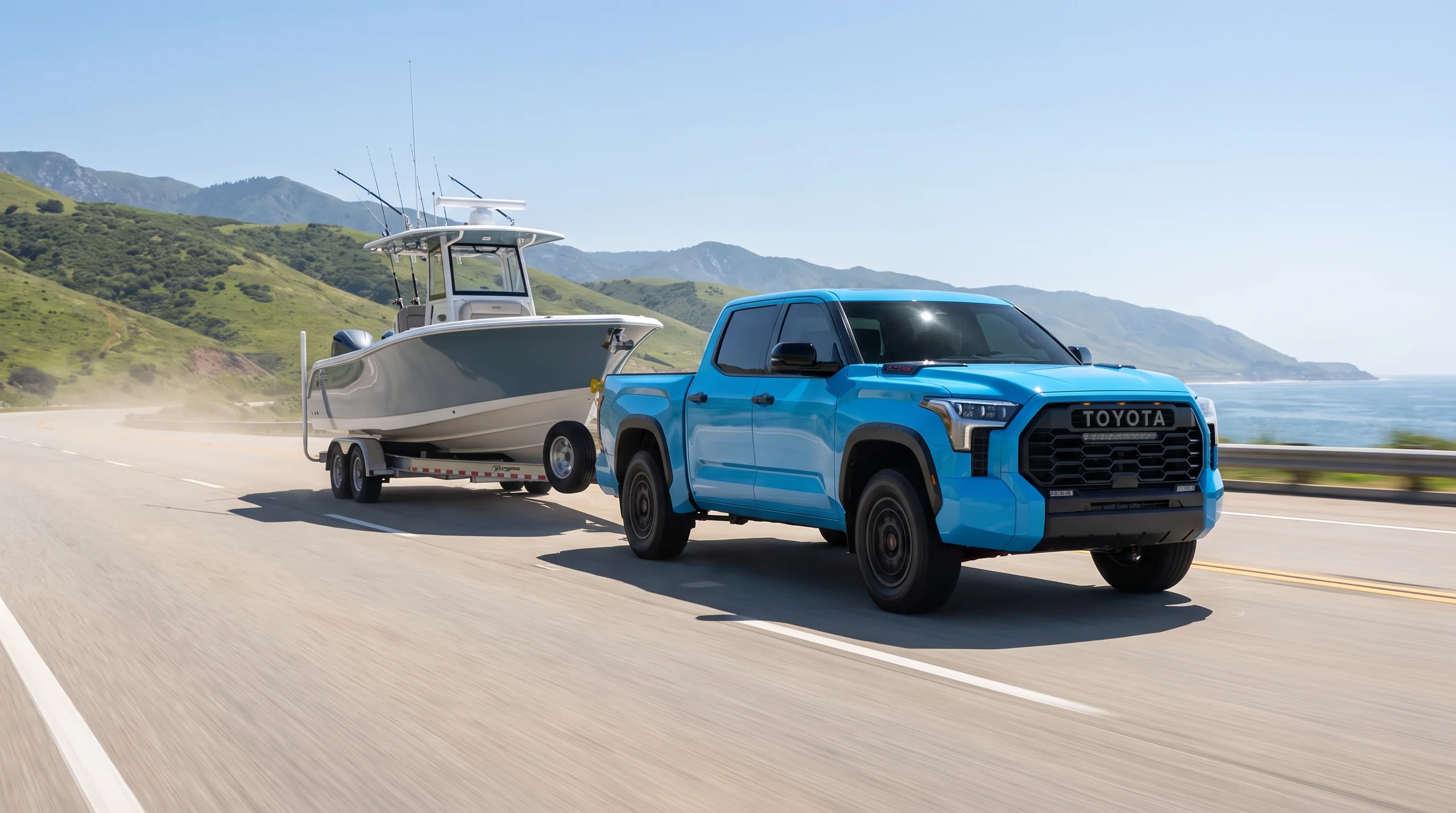
Tow ratings range from 8,300 to 12,000 pounds depending on grade, drivetrain, cab, and bed length. The maximum 12,000-pound rating is achieved by the SR5 Double Cab in rear-wheel drive with the 6.5-foot bed and the 389-horsepower i-FORCE V6. The i-FORCE MAX hybrid models top out at 11,450 pounds. A tow hitch receiver and 7-pin/4-pin connector are now standard on every 2026 grade, including the SR.
On the powertrain side, the 10-speed’s TOW/HAUL modes and uphill/downhill shift logic hold the appropriate gear under load, while the coil-spring multi-link rear suspension helps settle the truck with a trailer attached. Full configuration-by-configuration ratings are detailed on our 2026 Tundra towing capacity page.
Maximum towing and payload capacity figures are based on properly equipped vehicles and vary by configuration. Do not exceed any weight rating. See your owner’s manual and the vehicle’s door-jamb label for specific capacities.
Compare 2026 Tundra Powertrains at Tustin Toyota
Tustin Toyota stocks 2026 Tundra trucks with both the i-FORCE and i-FORCE MAX powertrains across multiple cab, bed, and drivetrain configurations. Drivers in Tustin, Irvine, Orange, Costa Mesa, Anaheim, Huntington Beach, and Corona can compare the two engines side by side on the lot rather than on a spec sheet.
Our sales team can walk you through which output level and drivetrain fit how you actually use a truck. Call (714) 909-2159 to check current availability, or browse the full 2026 Tundra inventory and i-FORCE MAX hybrid inventory online.
Common Questions About 2026 Toyota Tundra Engines
Does the 2026 Toyota Tundra offer a V8 engine?
No. Toyota retired the 5.7-liter V8 with the third-generation Tundra. The 2026 lineup uses only the twin-turbocharged 3.4-liter i-FORCE V6 and the i-FORCE MAX hybrid version of that engine. Both produce more torque than the previous V8, and from the SR5 grade upward, more horsepower as well.
Does the 2026 Tundra i-FORCE MAX hybrid need to be plugged in?
No. The i-FORCE MAX charges its battery automatically. Regenerative braking recovers energy during deceleration and the gas engine charges the battery as needed, so there is no plug and no charging station required.
What is the estimated driving range of the 2026 Tundra on a full tank?
Toyota does not publish a driving range specification for the Tundra. Using the standard 32.2-gallon tank and EPA combined estimates, a rear-wheel-drive gas Tundra rated at 20 mpg combined calculates to roughly 644 miles, and a four-wheel-drive model rated at 19 mpg combined to roughly 612 miles. These are calculations from EPA estimates rather than published range figures, and actual range will vary.
What factory warranty covers the 2026 Tundra hybrid components?
The 2026 Tundra carries a 36-month/36,000-mile basic warranty and a 60-month/60,000-mile powertrain warranty. On i-FORCE MAX models, hybrid-related components — including the battery control module, hybrid control module, and inverter with converter — are covered for 8 years/100,000 miles. The hybrid battery is covered for 10 years from the date of first use or 150,000 miles, whichever comes first. Full terms are published in Toyota’s 2026 Tundra warranty documentation.
This information is provided for general educational purposes only and does not constitute legal advice. Warranty coverage depends on the specific terms of your vehicle’s warranty agreement. Consult your owner’s manual or a qualified legal professional for guidance on your individual situation.
Disclaimers
EPA-estimated fuel economy figures are for comparison purposes only. Your actual mileage will vary depending on driving conditions, how you drive and maintain your vehicle, battery age/condition, and other factors.
Maximum towing and payload capacity figures are based on properly equipped vehicles and vary by configuration. Do not exceed any weight rating. See your owner’s manual and the vehicle’s door-jamb label for specific capacities.
This information is provided for general educational purposes only and does not constitute legal advice. Warranty coverage depends on the specific terms of your vehicle’s warranty agreement. Consult your owner’s manual or a qualified legal professional for guidance on your individual situation.