

Hybrid, Plug-In Hybrid, or Electric: How to Choose the Right Toyota in Tustin
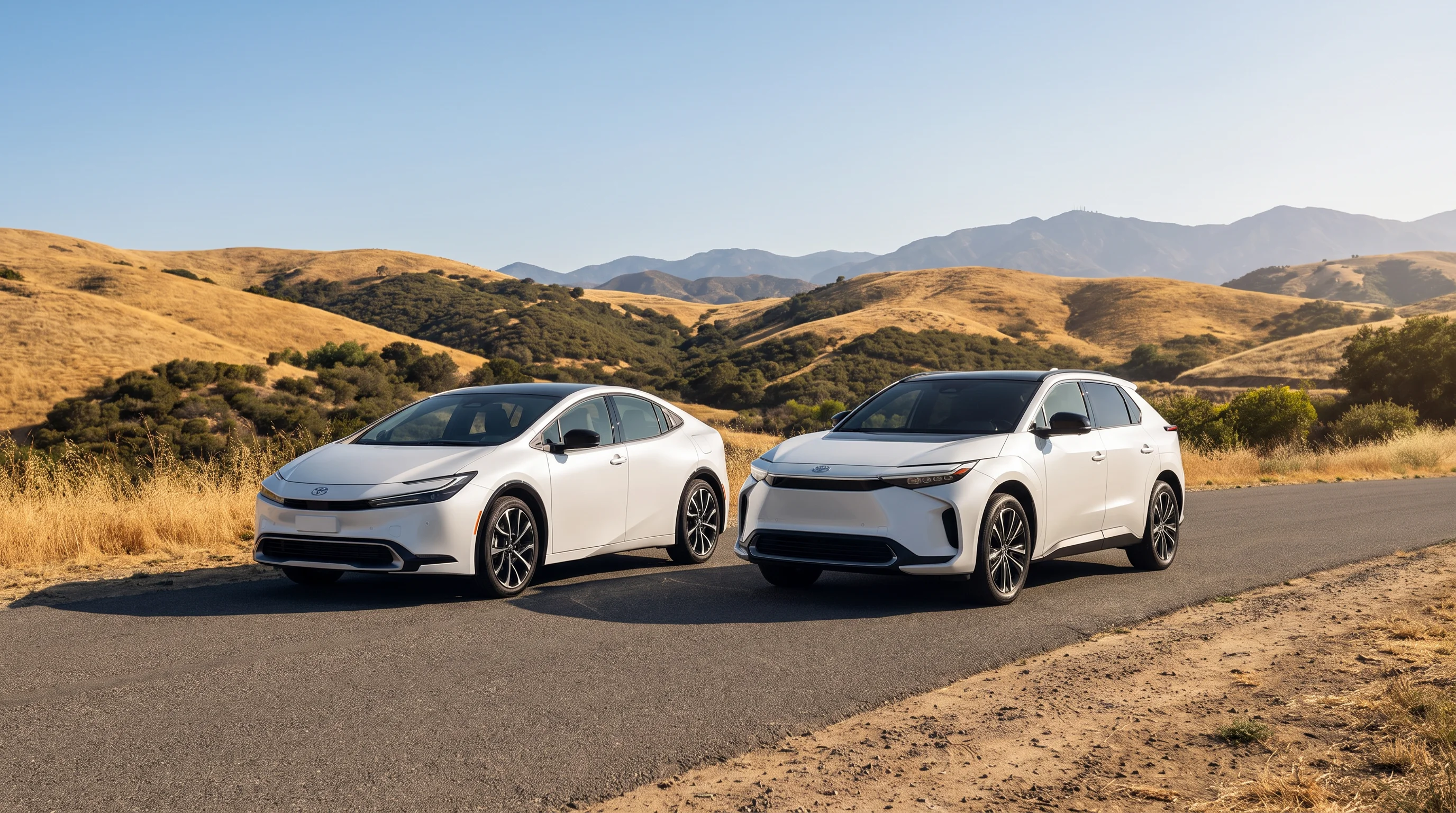
Choosing between a Toyota hybrid, plug-in hybrid, and fully electric model comes down to a few practical questions. What can you plug into? How far do you drive each day? And what will you spend to keep it moving?
A hybrid (HEV) pairs a gas engine with an electric motor and recharges itself. You never plug it in. A plug-in hybrid (PHEV) adds a larger battery and a charge port, so it delivers real all-electric range before reverting to hybrid operation. A battery electric vehicle (BEV) runs on stored electricity alone, with no gas engine and no tailpipe emissions. For the engineering behind each system, our guide to how Toyota’s hybrid, plug-in hybrid, and electric powertrains work covers it in depth. This page is about running costs and model fit.
Which Toyota Models Come as Hybrid, Plug-In Hybrid, or Electric?
Toyota’s 2026 lineup is electrified across nearly every segment. The three powertrain types are not interchangeable, though. Here is how the lineup Tustin Toyota carries breaks down.
| Hybrid (HEV) | Plug-In Hybrid (PHEV) | Electric (BEV) | |
|---|---|---|---|
| 2026 Toyota models | Prius, Camry, Corolla Hybrid, Corolla Cross Hybrid, RAV4 Hybrid, Highlander Hybrid, Grand Highlander Hybrid, Crown, Crown Signia, Sienna, Sequoia, Land Cruiser, Tundra i-FORCE MAX, Tacoma i-FORCE MAX, 4Runner i-FORCE MAX | Prius Plug-in Hybrid, RAV4 Plug-in Hybrid | bZ, bZ Woodland, C-HR |
| How you fuel it | Gas only — never plugs in | Gas, plus an optional plug | Plug only |
| All-electric driving | None — the motor assists, it does not drive the car alone | EPA-estimated 44 miles on Prius Plug-in Hybrid, up to 54 miles on RAV4 Plug-in Hybrid SE | Full-time — see the BEV range table below |
| Suits you if you want | Plug-free convenience | Dual-fuel versatility | Zero-emission driving |
EPA-estimated fuel economy figures are for comparison purposes only. Your actual mileage will vary depending on driving conditions, how you drive and maintain your vehicle, battery age/condition, and other factors.
Families needing three-row seating gravitate to the Sienna or Grand Highlander Hybrid. Drivers who want everyday versatility tend to land on the RAV4 Hybrid or the RAV4 Plug-in Hybrid, which comes with all-wheel drive standard on every trim.
Toyota’s Three Electric Models at a Glance
All three Toyota BEVs ride on the same electric-only platform. All three carry a native North American Charging System port, which means direct access to Tesla Supercharger stations without an adapter.
| Model | Battery | EPA-Estimated Range | Horsepower | Drivetrain |
|---|---|---|---|---|
| bZ | 57.7 kWh or 74.7 kWh | 236 to 314 miles by grade | 168 hp on base XLE FWD | FWD or AWD |
| bZ Woodland | 74.7 kWh | 281 miles, or 260 miles with all-terrain tires | 375 hp | AWD standard |
| C-HR | 74.7 kWh | 287 miles on SE, 273 miles on XSE | 338 hp | AWD standard |
EPA-estimated fuel economy figures are for comparison purposes only. Your actual mileage will vary depending on driving conditions, how you drive and maintain your vehicle, battery age/condition, and other factors.
These figures are published by Toyota for the 2026 bZ, the 2026 bZ Woodland, and the 2026 C-HR. On DC fast charging, all three recharge from 10% to 80% in around 30 minutes under ideal conditions. For a closer look at one of them, see our breakdown of the 2026 bZ’s range and charging specs.
What Does It Cost to Charge Versus Fuel in Orange County?
Your Rate Plan Matters More Than Your Car
Charging at home off-peak is generally cheaper per mile than buying gas. How much cheaper depends on your utility and your rate plan. Southern California Edison’s off-peak home rates now run from the mid-20s to the mid-30s in cents per kilowatt-hour. That varies by plan and by season. Parts of Orange County are served by municipal utilities on entirely different schedules. Check which plan you are on before you model your own payback. The gap between an EV-optimized time-of-use plan and a default plan is wider than the gap between most vehicles.
What You Are Comparing Against
The answer also depends on the gas vehicle in the comparison. A Prius LE returns an EPA-estimated 57 mpg city and 56 mpg highway. That is thrifty enough to shrink the per-mile edge that charging holds. Against a 25-mpg gas SUV, the math looks very different. Work from your own annual mileage and your actual rate. Those two numbers matter more than any published average.
EPA-estimated fuel economy figures are for comparison purposes only. Your actual mileage will vary depending on driving conditions, how you drive and maintain your vehicle, battery age/condition, and other factors.
Is a Toyota Plug-In Hybrid Faster Than a Standard Hybrid?
Yes. The plug-in system pairs a bigger battery with stronger drive motors, and the gap in output is wide. The 2026 RAV4 Plug-in Hybrid produces 324 net combined horsepower on Toyota’s sixth-generation plug-in system. The 2026 RAV4 Hybrid uses the fifth-generation hybrid system and produces 226 horsepower with front-wheel drive, or 236 horsepower with all-wheel drive, according to Toyota.
The edge comes from how much power the bigger battery can send out at once. On a freeway onramp, the electric motor adds torque at once, before the gas engine hits its stride. Standard hybrids remain responsive for daily driving. They are tuned for efficiency rather than outright pace. The plug-in is the quicker vehicle by a clear margin.
Common Questions
How far can a Toyota plug-in hybrid drive on electricity alone?
Toyota’s two plug-in hybrids deliver an EPA-estimated 44 miles of all-electric range on the Prius Plug-in Hybrid and up to 54 miles on the RAV4 Plug-in Hybrid SE. That covers most local errands and typical commutes on battery power. After that, the vehicle transitions into conventional gas-electric hybrid operation.
EPA-estimated fuel economy figures are for comparison purposes only. Your actual mileage will vary depending on driving conditions, how you drive and maintain your vehicle, battery age/condition, and other factors.
Do hybrids and EVs cost less to maintain than gas vehicles?
Routine maintenance is often comparable or lower. Regenerative braking does much of the decelerating, so friction brake components typically wear more slowly. Battery electric vehicles have no engine oil or spark plugs to replace at all. Plug-in hybrids and standard hybrids still carry a gas engine, and that engine still needs its routine service.
The information in this article is general guidance and does not constitute a specific diagnostic or repair recommendation for any individual vehicle. Repair and maintenance decisions should be made in consultation with a certified technician based on the specific condition of your vehicle.
Find Your Electrified Toyota
The right choice comes down to two things: charging access and daily mileage. If you can plug in at home, start with the bZ, bZ Woodland or C-HR. If you cannot reliably charge, a standard hybrid delivers the efficiency without changing anything about how you refuel. A plug-in hybrid sits between the two and asks you to commit to neither.
Visit us at 36 Auto Center Dr, Tustin, CA 92782, or call our sales team at (714) 909-2159.
Disclaimers
EPA-estimated fuel economy figures are for comparison purposes only. Your actual mileage will vary depending on driving conditions, how you drive and maintain your vehicle, battery age/condition, and other factors.
The information in this article is general guidance and does not constitute a specific diagnostic or repair recommendation for any individual vehicle. Repair and maintenance decisions should be made in consultation with a certified technician based on the specific condition of your vehicle.
0 comment(s) so far on Hybrid, Plug-In Hybrid, or Electric: How to Choose the Right Toyota in Tustin