
How Toyota Safety Sense Works in Real Life
TSS 2.5 vs. 3.0 for Tustin Drivers
Toyota Safety Sense (TSS) is more than a features list on a window sticker — it is a suite of driver-assistance technologies designed to help prevent accidents, reduce driver fatigue, and build confidence during everyday driving. As Toyota has evolved the system from version 2.5 to the newer 3.0, the upgrades translate into tangible improvements that drivers in Tustin and across Orange County notice on their daily commutes, weekend errands, and highway trips.
This guide breaks down the key differences between TSS 2.5 and TSS 3.0, explains what each feature actually does behind the wheel, and highlights which 2026 Toyota models come equipped with the latest technology.
What Changed from TSS 2.5 to TSS 3.0?
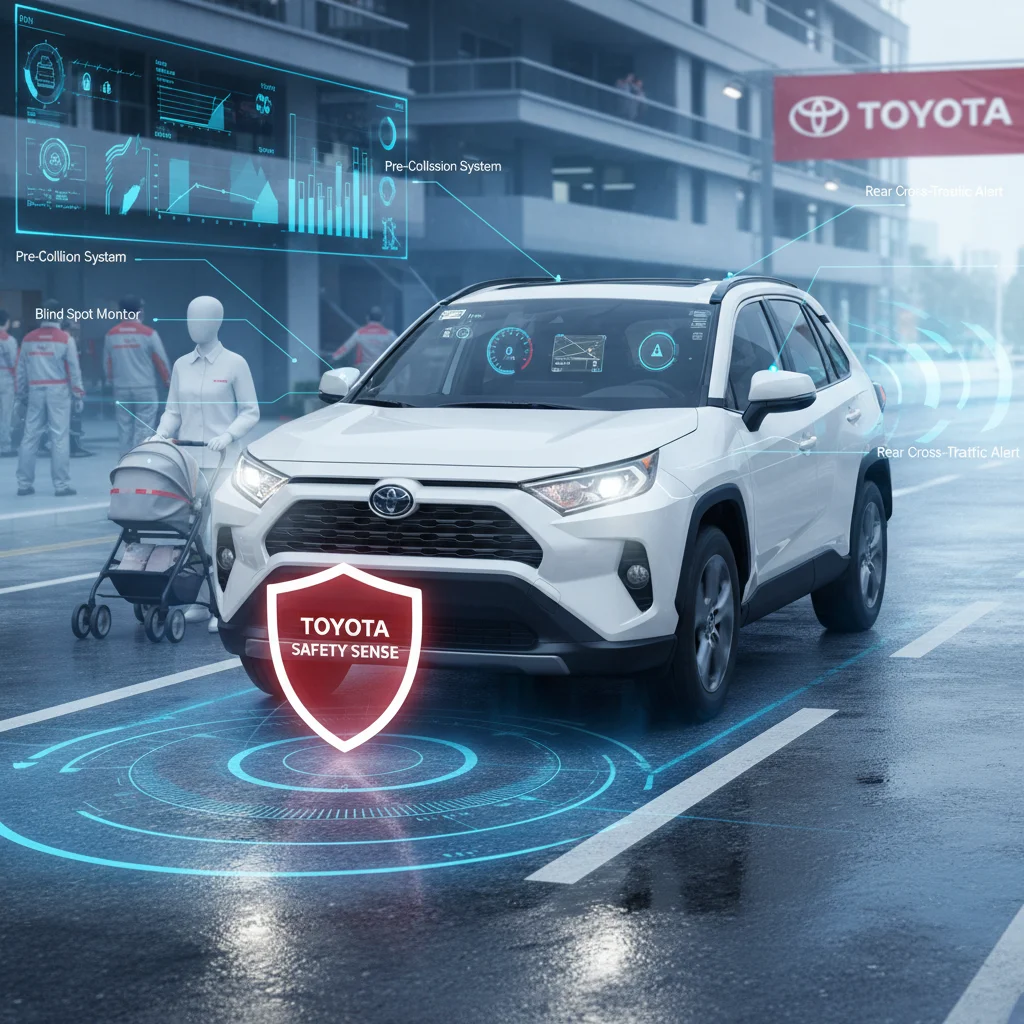
The transition from TSS 2.5 to 3.0 involves both hardware and software upgrades. TSS 3.0 uses a higher-resolution, wider-angle front-facing camera paired with an improved millimeter-wave radar sensor. Together, these upgrades give the system a broader field of view, faster processing, and more accurate object classification — meaning it can detect hazards earlier and respond more precisely.
Some TSS 3.0-equipped vehicles also support over-the-air software updates, allowing Toyota to refine system behavior without requiring a dealership visit.
Pre-Collision System with Pedestrian Detection
Both TSS 2.5 and 3.0 include the Pre-Collision System (PCS), which uses radar and camera data to identify potential frontal collisions. When a risk is detected, the system alerts the driver with audible and visual warnings. If the driver does not respond, automatic emergency braking engages to reduce speed or avoid impact.
TSS 3.0 expands PCS detection to include motorcyclists alongside vehicles, pedestrians, and bicyclists. The upgraded camera also provides better intersection support, detecting oncoming vehicles in more than one lane during turns and vehicles approaching from lateral directions. For drivers navigating busy intersections in Anaheim or pedestrian-heavy areas near Tustin schools and parks, this wider detection capability provides meaningful added protection.
The system also includes Pre-Collision Throttle Management, which reduces engine output when a potential collision is detected — preventing unintended acceleration in stop-and-go situations.
Dynamic Radar Cruise Control
Toyota’s adaptive cruise control system, Dynamic Radar Cruise Control (DRCC), maintains a preset following distance by automatically adjusting speed based on traffic flow. Standard DRCC is designed for speeds above 20 mph, while Full-Speed Range DRCC extends operation down to a complete stop — a critical upgrade for freeway commuters dealing with congestion on the I-5 corridor between Tustin and Anaheim.
TSS 3.0 refines the acceleration and deceleration behavior, producing smoother speed transitions that reduce the abrupt braking and throttle changes some drivers noticed in earlier versions. The system also now detects vehicles in adjacent lanes and offers an additional following distance setting, giving drivers more control over how the system behaves.
Lane Departure Alert and Lane Tracing Assist
Lane Departure Alert with Steering Assist (LDA) monitors lane markings and road-edge boundaries at speeds above approximately 30 mph. When unintentional lane drift is detected, the system issues a warning and provides gentle corrective steering. TSS 3.0 enhances this feature by using additional objects like guardrails to define the road edge — helpful on suburban roads around Huntington Beach or Costa Mesa where lane markings may be faded or inconsistent.
Lane Tracing Assist (LTA) goes a step further when DRCC is active, using lane markers and the path of the vehicle ahead to actively help keep the vehicle centered. This combination of DRCC and LTA creates a semi-automated driving experience that significantly reduces fatigue during extended freeway drives.
Two Features Exclusive to TSS 3.0
Emergency Driving Stop System
Available on TSS 3.0 vehicles equipped with a driver monitor camera, EDSS watches for signs of driver inattentiveness while Lane Tracing Assist is active. If the driver fails to respond to prompts to resume control, the system can bring the vehicle to a safe stop under certain conditions. This feature provides an additional safety layer for situations involving driver incapacitation — reassuring for families commuting through suburban environments.
Proactive Driving Assist
Proactive Driving Assist uses the vehicle’s camera and radar to provide gentle braking when approaching curves and subtle steering and braking support to maintain safe distances from vehicles, pedestrians, and bicyclists ahead. PDA operates in the background, making its adjustments feel natural rather than intrusive. Drivers navigating tight turns in residential neighborhoods or variable-speed zones near shopping districts will notice the system’s quiet, steady support.
Road Sign Assist and Automatic High Beams
Road Sign Assist (RSA) uses the forward-facing camera to detect speed limit signs, stop signs, yield signs, and Do Not Enter signs, displaying them on the Multi-Information Display. TSS 3.0 expands the range of recognizable signs and improves detection accuracy, which is particularly useful in areas with frequent speed limit changes due to school zones or construction.
Automatic High Beams (AHB) toggle between high and low beams based on surrounding traffic conditions at speeds above 21 mph. While this feature does not see major changes in TSS 3.0, it continues to enhance nighttime visibility on less illuminated suburban roads throughout Orange County.
TSS 2.5 vs. TSS 3.0 at a Glance
| Feature | TSS 2.5 | TSS 3.0 |
|---|---|---|
| Pre-Collision Detection | Vehicles, pedestrians, bicyclists | Adds motorcyclists, improved intersection support |
| Dynamic Radar Cruise Control | Adaptive cruise above 20 mph | Smoother transitions, adjacent lane detection, additional following distance setting |
| Lane Departure Alert | Detects lane markings above ~30 mph | Adds road-edge detection using guardrails and other objects |
| Emergency Driving Stop System | Not available | Monitors driver attentiveness, can stop vehicle if unresponsive |
| Proactive Driving Assist | Not available | Gentle braking and steering support for curves and distance control |
| Road Sign Assist | Basic sign recognition | Expanded sign types and improved accuracy |
| Automatic High Beams | Standard | No major changes |
| Over-the-Air Updates | Not available | Supported on select models |
Which 2026 Toyota Models Have TSS 3.0?
Most 2026 Toyota passenger vehicles come standard with Toyota Safety Sense 3.0, including popular models like the Camry, Corolla, Prius, RAV4, Tacoma, and Corolla Cross. Full-size trucks and SUVs such as the Sequoia retain TSS 2.5, which is specifically tuned for larger vehicle dynamics but still includes robust safety coverage including PCS, Full-Speed Range DRCC, and LDA.
Performance-focused models like the GR Supra and GR86 use their own vehicle-specific safety systems rather than the standard TSS package, though they include features like Pre-Collision System with Pedestrian Detection, Lane Departure Warning, and Adaptive Cruise Control.
For drivers in the Tustin area who want to experience TSS 3.0 firsthand, exploring the current Toyota lineup at Tustin Toyota is the best way to see how these features perform on the roads you drive every day.
Experience Toyota Safety Sense at Tustin Toyota
Whether you are commuting on Southern California freeways, navigating school zones, or driving through busy commercial areas in Orange County, Toyota Safety Sense 3.0 provides a measurable upgrade in awareness, comfort, and confidence behind the wheel. These systems are designed to assist attentive drivers — not replace them — and their real-world value comes through during the everyday moments that matter most.
Visit us at 36 Auto Center Dr, Tustin, CA 92782 or call our sales team at 714-909-2159 for personalized guidance.
0 comment(s) so far on How Toyota Safety Sense Works in Real Life