
Toyota Hybrid Buying Guide: Which Toyota Hybrid Fits You in Tustin?
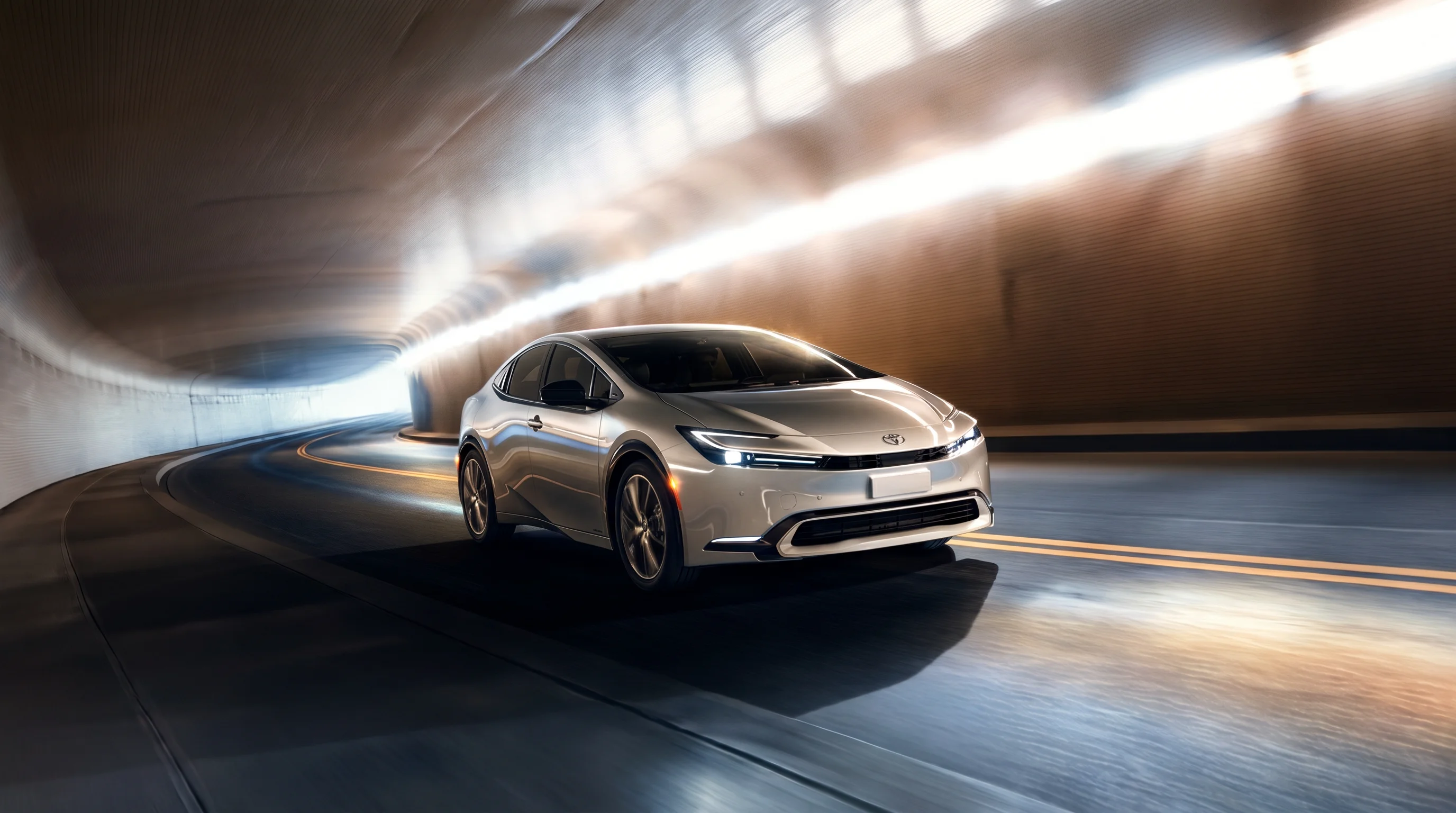
Toyota builds three main types of hybrid powertrains: standard hybrids, plug-in hybrids and the performance-focused i-FORCE MAX hybrid. Standard hybrids pair a gas engine with electric motor-generators. They recharge themselves through the engine and regenerative braking, so you never plug them in. Plug-in hybrids carry a larger battery that you charge from an outlet. That gives you a stretch of all-electric driving before they switch to hybrid operation. i-FORCE MAX places an electric motor between a turbocharged engine and an automatic transmission. The result is strong low-end torque in Toyota’s trucks and body-on-frame SUVs. This guide walks through each type so you can match a Toyota hybrid to how you actually drive.
Toyota Hybrid Types at a Glance
Each hybrid type solves a different problem. The table below shows how each one charges and where it fits best.
| Hybrid type | How it charges | Best fit | Example Toyota models |
|---|---|---|---|
| Standard hybrid (HEV) | Self-charging through the engine and regenerative braking — never plugs in | Drivers who want better fuel economy with no change to their routine | Prius, Camry, Corolla Hybrid, RAV4 Hybrid |
| Plug-in hybrid (PHEV) | Plugs in to recharge a larger battery, then runs as a hybrid | Drivers with home charging and shorter daily trips | RAV4 Plug-in Hybrid, Prius Plug-in Hybrid |
| i-FORCE MAX hybrid | Self-charging; electric motor sits between the turbocharged engine and the automatic transmission | Drivers who tow, haul or head off-road | Tundra, Tacoma, Sequoia, Land Cruiser, 4Runner |
Which Toyota Hybrid Fits Your Driving?
Visiting our showroom at 36 Auto Center Dr in Tustin? Start with what matters most to you:
| Your priority | Hybrid type to consider | Toyota models to start with |
|---|---|---|
| Maximum fuel savings | Standard hybrid | Prius |
| Everyday SUV versatility | Standard hybrid | RAV4 Hybrid |
| Electric driving for daily trips with home charging | Plug-in hybrid | RAV4 Plug-in Hybrid |
| Towing and heavy-duty capability | i-FORCE MAX hybrid | Tundra i-FORCE MAX |
If you can’t charge at home, a standard hybrid delivers its efficiency with no change to your routine. If you can plug in at home, a plug-in hybrid lets you do more of your driving on electricity. If you need to tow or explore off-road, the i-FORCE MAX trucks and SUVs are built for that work. Explore the full Toyota electrified lineup to see which models fit your list.
Standard Hybrid or Plug-In Hybrid: Which Fits Your Commute?
A standard Toyota hybrid makes all of its own electricity. It uses the gas engine and energy recovered through regenerative braking. A plug-in hybrid also charges from an outlet. That lets you cover a stretch of daily driving on electricity alone before the gas engine is needed.
| Feature | Standard hybrid | Plug-in hybrid |
|---|---|---|
| Fuel source | Gasoline only | Gasoline plus electricity from the grid |
| Plugging in | Not needed | Plug in to recharge for electric driving |
| Electric-only driving | Short distances at low speed using EV Mode | Up to a manufacturer-estimated 52 miles on the RAV4 Plug-in Hybrid SE and XSE |
Fuel economy figures shown are manufacturer estimates; the EPA has not yet rated this vehicle. Manufacturer-estimated figures are for comparison purposes only. Your actual mileage will vary depending on driving conditions, how you drive and maintain your vehicle, battery age/condition, and other factors.
How Each Type Fits a Daily Routine
A standard hybrid asks nothing new of you. You fill up with gas, and it recovers energy through regenerative braking on its own. A plug-in hybrid works with you more. The 2027 Prius Plug-in Hybrid, for example, runs in EV, Auto EV/HV and Hybrid modes depending on driving conditions and battery charge.
Commuting from Huntington Beach with a charger at home? A plug-in hybrid can handle many daily errands on electric power. It then runs as a standard hybrid on longer drives. For a deeper look at charging, battery size and cost, see our hybrid vs. plug-in hybrid comparison.
Which Toyota Hybrids Get the Best Fuel Economy?
Among Toyota’s non-plug-in hybrids, the 2027 Prius earns the top EPA-estimated combined rating. Here is how popular Toyota hybrids compare:
| Model and grade | Estimated City MPG | Estimated Highway MPG | Estimated Combined MPG |
|---|---|---|---|
| 2027 Prius LE FWD (EPA-Estimated) | 59 | 50 | 55 |
| 2027 Prius LE AWD (EPA-Estimated) | 56 | 49 | 53 |
| 2027 Corolla Hybrid LE FWD (Estimated) | 53 | 46 | 50 |
| 2026 Camry LE AWD (EPA-Estimated) | 50 | 49 | 50 |
| 2026 RAV4 Hybrid XLE Premium AWD (EPA-Estimated) | 45 | 38 | 41 |
EPA-estimated fuel economy figures are for comparison purposes only. Your actual mileage will vary depending on driving conditions, how you drive and maintain your vehicle, battery age/condition, and other factors.
Fuel economy figures shown are manufacturer estimates; the EPA has not yet rated this vehicle. Manufacturer-estimated figures are for comparison purposes only. Your actual mileage will vary depending on driving conditions, how you drive and maintain your vehicle, battery age/condition, and other factors.
The 2027 Corolla Hybrid figures are manufacturer estimates; the EPA has not yet rated that model. Real-world results depend on how and where you drive.
What Helps Toyota Hybrids Save Fuel
Toyota rates the hybrid version of its 2.5-liter Dynamic Force engine at 41% thermal efficiency. That helps turn more of every gallon into motion. On the Prius, a selectable EV Mode lets you drive short distances at low speed on electric power alone, such as in parking garages.
Which Toyota Hybrids Offer Electronic On-Demand All-Wheel Drive?
Toyota offers Electronic On-Demand All-Wheel Drive across much of its hybrid lineup. Instead of a driveshaft to the rear wheels, it uses a separate electric motor at the rear axle. That motor powers the rear wheels when needed. Here is where you’ll find hybrid AWD:
| Model | Hybrid AWD availability |
|---|---|
| 2027 Prius | Electronic On-Demand AWD available on every grade |
| 2027 Corolla Hybrid | Electronic On-Demand AWD available on LE and SE |
| 2026 Camry | Electronic On-Demand AWD available on every grade |
| 2026 RAV4 Hybrid | Electronic On-Demand AWD available on LE, XLE Premium and SE; standard on XSE, Woodland and Limited |
| 2026 RAV4 Plug-in Hybrid | AWD standard on every grade, powered by a dedicated rear electric motor |
| 2027 Crown | Electronic On-Demand AWD on XLE, Limited and Nightshade; Full-Time Electronic AWD with Hybrid MAX on Platinum |
| 2026 Highlander Hybrid | Electronic On-Demand AWD standard on every grade |
| 2026 Sienna | Electronic On-Demand AWD standard on Woodland and Platinum; available on LE, XLE, XSE and Limited |
Considering a Highlander Hybrid? The next-generation 2028 Highlander moves to a battery-electric powertrain.
How Electronic On-Demand AWD Works
The rear motor works when it is needed. It sends drive force to the rear wheels as you pull away from a stop, which helps limit front-wheel slip. It also engages when sensors detect slip at the front wheels. You give up little at the pump. The 2027 Prius LE is EPA-estimated at 55 mpg combined with FWD and 53 mpg combined with AWD.
EPA-estimated fuel economy figures are for comparison purposes only. Your actual mileage will vary depending on driving conditions, how you drive and maintain your vehicle, battery age/condition, and other factors.
Traction From a Stop
The rear motor sends drive force to the rear wheels as you pull away and when the front wheels slip.
Efficiency-Minded Design
The rear motor works when it is needed, helping AWD models stay close to the EPA-estimated fuel economy of their FWD versions.
No Rear Driveshaft
Toyota’s design skips the heavy transfer case and space-robbing driveshaft of a conventional AWD system.
Drivers from Corona to Irvine can check current availability of AWD hybrids in our new Toyota inventory.
Which Toyota Vehicles Use the i-FORCE MAX Hybrid?
Toyota uses its i-FORCE MAX hybrid in its trucks and body-on-frame SUVs: the Tundra, Tacoma, Sequoia, Land Cruiser and 4Runner. The system pairs a turbocharged engine with a 48-horsepower electric motor-generator. That motor sits between the engine and a multi-speed automatic transmission.
| Model | Engine | Net combined output | Transmission | i-FORCE MAX availability |
|---|---|---|---|---|
| Tundra | 3.4L twin-turbo V6 | 437 hp / 583 lb-ft | 10-speed automatic | Available on select grades |
| Sequoia | 3.4L twin-turbo V6 | 437 hp / 583 lb-ft | 10-speed automatic | Only powertrain offered |
| Tacoma | 2.4L turbo 4-cylinder | Up to 326 hp / 465 lb-ft | 8-speed automatic | Standard on TRD Pro and Trailhunter; available on TRD Sport, TRD Off-Road and Limited |
| 4Runner | 2.4L turbo 4-cylinder | 326 hp / 465 lb-ft | 8-speed automatic | Standard on Platinum, TRD Pro and Trailhunter; available on TRD Off-Road, TRD Off-Road Premium and Limited |
| Land Cruiser | 2.4L turbo 4-cylinder | 326 hp / 465 lb-ft | 8-speed automatic | Only powertrain offered |
Why the Motor Placement Matters
Placing the motor-generator between the engine and the transmission lets electric torque assist the engine from low speeds. On the Tundra i-FORCE MAX, peak torque of 583 lb-ft arrives at just 2,400 rpm. That low-end pulling power helps full-size trucks and SUVs tow and climb grades. For a closer look at the Tundra’s powertrains, see our 2026 Tundra engine specs.
Shopping for a Toyota Hybrid at Tustin Toyota
Finding the right hybrid starts with your daily routine, your space needs and your performance priorities. A Toyota Prius maximizes fuel savings. A Toyota RAV4 Hybrid adds everyday SUV versatility. A Toyota Tundra i-FORCE MAX brings heavy-duty power. Toyota’s electrified lineup has an option for you.
Ready to compare Toyota hybrids in person or take a test drive? Visit us at 36 Auto Center Dr in Tustin, or call our sales team at (714) 909-2159.
Toyota Hybrid Buying Questions
What hybrid components does Toyota’s factory warranty cover?
Toyota covers hybrid-related components, including the battery control module, hybrid control module and inverter with converter, for 8 years or 100,000 miles. For model year 2020 and newer Toyota hybrids, the hybrid battery itself is covered for 10 years from the date of first use or 150,000 miles, whichever comes first. New Toyotas also include ToyotaCare, which covers normal factory-scheduled maintenance for 1 year or 10,000 miles, whichever comes first. Roadside assistance terms vary by model.
This information is provided for general educational purposes only and does not constitute legal advice. Warranty coverage depends on the specific terms of your vehicle’s warranty agreement. Consult your owner’s manual or a qualified legal professional for guidance on your individual situation.
How does a Toyota hybrid keep its battery cool?
Many Toyota hybrids, including the Prius, Camry and RAV4 hybrid models, cool the hybrid battery with a fan that draws air through an intake filter. A Toyota service bulletin notes that dust or debris in the battery cooling fan or filter can turn on the check-engine light, so a technician may need to inspect and clean them.
Are federal tax credits available for a new Toyota hybrid?
No. Under federal legislation enacted in July 2025, the new clean vehicle tax credit is not available for vehicles acquired after September 30, 2025. The main financial benefits of hybrid ownership today are fuel savings and Toyota’s factory warranty coverage.
Rebate and incentive program terms, funding availability, eligibility requirements, and deadlines are set by the administering agency and are subject to change or exhaustion of funds without notice. Amounts shown are maximums, not guarantees; actual rebate value depends on eligible costs and agency review. This dealership does not administer these programs and does not provide tax or legal advice. Confirm current requirements directly with the administering agency and consult a qualified tax professional regarding any tax consequences.
Disclaimers
EPA-estimated fuel economy figures are for comparison purposes only. Your actual mileage will vary depending on driving conditions, how you drive and maintain your vehicle, battery age/condition, and other factors.
Fuel economy figures shown are manufacturer estimates; the EPA has not yet rated this vehicle. Manufacturer-estimated figures are for comparison purposes only. Your actual mileage will vary depending on driving conditions, how you drive and maintain your vehicle, battery age/condition, and other factors.
This information is provided for general educational purposes only and does not constitute legal advice. Warranty coverage depends on the specific terms of your vehicle’s warranty agreement. Consult your owner’s manual or a qualified legal professional for guidance on your individual situation.
Rebate and incentive program terms, funding availability, eligibility requirements, and deadlines are set by the administering agency and are subject to change or exhaustion of funds without notice. Amounts shown are maximums, not guarantees; actual rebate value depends on eligible costs and agency review. This dealership does not administer these programs and does not provide tax or legal advice. Confirm current requirements directly with the administering agency and consult a qualified tax professional regarding any tax consequences.
0 comment(s) so far on Toyota Hybrid Buying Guide: Which Toyota Hybrid Fits You in Tustin?